
What Do Cliburn, Kantorow, and Tchaikovsky Have in Common?
March 6, 2026
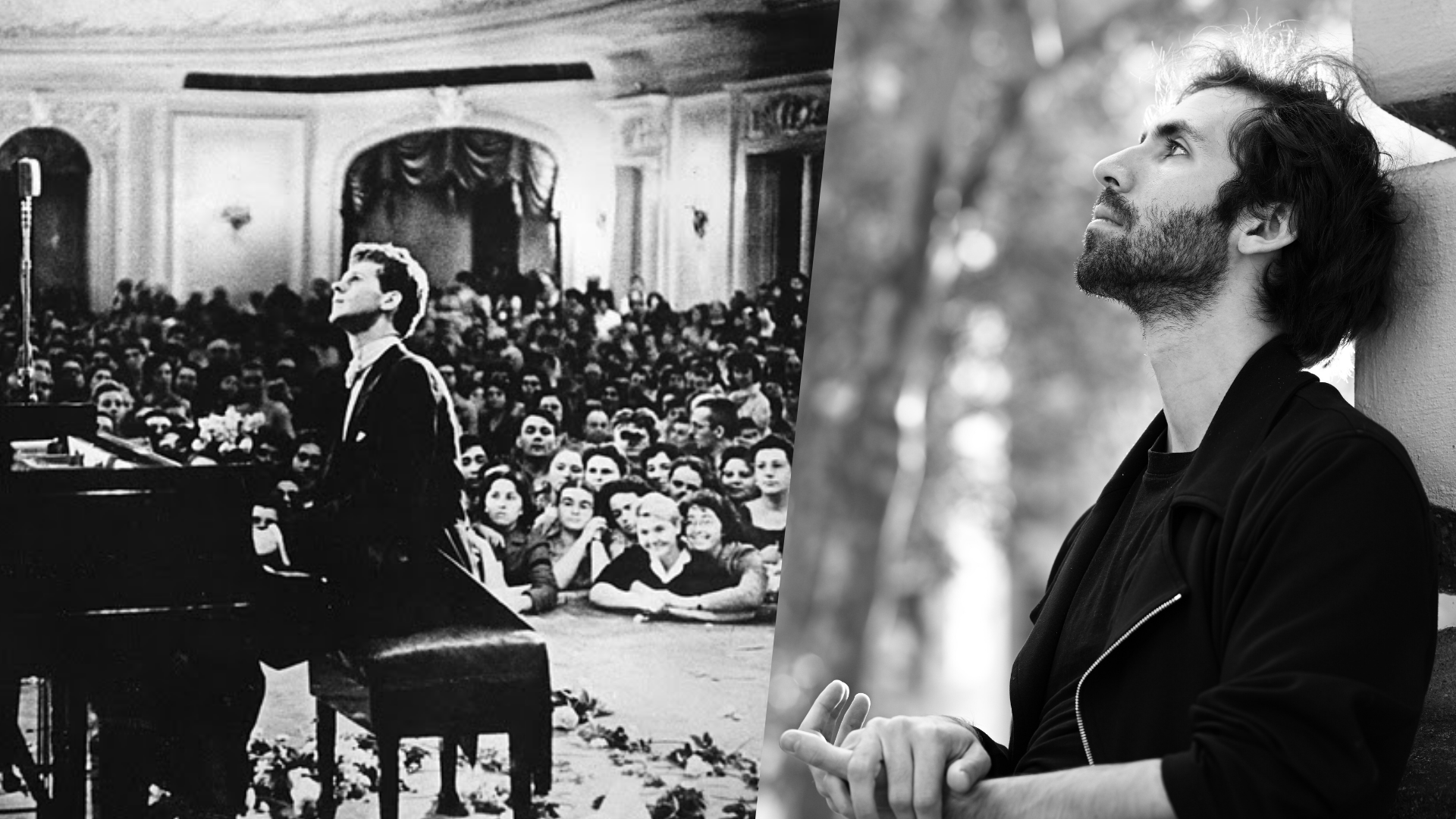
On May 1, 2026, the Gilmore Piano Festival presents a concert built around a remarkable thread of musical history—one that weaves together Van Cliburn, Alexandre Kantorow, and Pyotr Ilyich Tchaikovsky.
At first glance, these three names span different eras, continents, and artistic identities. But look a little closer and a deeper connection begins to emerge. Our May 1 program brings that connection vividly to life in two unforgettable acts.
Act One: Van Cliburn — A Musical Moment That Changed the World
Van Cliburn was more than a virtuoso pianist. He was, in many ways, a cultural bridge.
In 1958, at the height of the Cold War, a 23-year-old American pianist traveled to Moscow to compete in the first International Tchaikovsky Competition. Against all political odds, Cliburn won. His performances of Tchaikovsky’s First Piano Concerto and Rachmaninoff’s Third were so electrifying that even the Soviet judges and audiences embraced him. Legend has it that the judges sought permission from Nikita Khrushchev himself before awarding the top prize to an American.
Cliburn’s victory became a global symbol of how art can transcend ideology. In a world divided by fear and suspicion, music briefly united millions.
But Cliburn also holds a special place in Gilmore history. In 1991, at the very first Gilmore Piano Festival, Van Cliburn took the stage. His presence signaled something important: that Kalamazoo would become a place where the highest ideals of pianism—artistry, humanity, and depth—would be celebrated.
On May 1, we honor that legacy with a compelling mini-opera for baritone, piano, and ensemble centered on Cliburn’s extraordinary journey. American Sputnik, brought to life by award-winning composer Evan Mack and Pulitzer Prize-winning librettist Mark Campbell, is not simply a biographical retelling. Co-commissioned with our friends at the Kalamazoo Symphony Orchestra, it is a dramatic exploration of the moment when one young musician stepped onto a stage and altered the cultural narrative of his time.
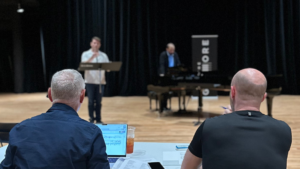 A photo from one of the first American Sputnik rehearsals.
Through voice and piano, we revisit the tension of the Cold War, the charged atmosphere of Moscow in 1958, and the overwhelming humanity of music that rose above politics. It is intimate and theatrical, deeply moving, and ultimately a reflection on courage, youth, and the way art can transform the world around it.
Act Two: Alexandre Kantorow — The Next Chapter of a Legacy
If Act One reflects on history, Act Two shows us how that history lives on.
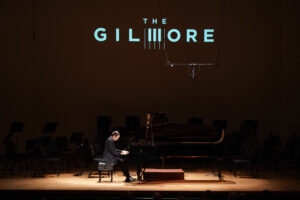
Alexandre Kantorow, one of the most thrilling pianists of his generation, also won the International Tchaikovsky Competition. And like Cliburn, he did so with performances that left audiences astonished. In 2019, Kantorow became the first French pianist to win the Gold Medal at the competition. His triumph reaffirmed the Tchaikovsky Competition’s status as one of the great proving grounds of pianistic artistry.
On May 1, Kantorow will perform Tchaikovsky’s Piano Concerto No. 2 with the KSO led by Julian Kuerti—the very concerto he played in Moscow on his path to victory.
Tchaikovsky’s Second Concerto is monumental and expansive, full of lyricism. It demands not only technical brilliance but also emotional breadth and a deep sensitivity to the dialogue within the orchestra. It is a work that invites pianists to inhabit a vast emotional landscape—from thunderous grandeur to intimate, singing lines.
There is something profoundly poetic about hearing Kantorow perform this concerto in the context of a program that also honors Cliburn. Two young pianists, separated by more than sixty years, each stepping onto the same international stage. Each winning the same competition. Each performing Tchaikovsky as a declaration of artistic truth.
What Do They Have in Common?
Cliburn, Kantorow, and Tchaikovsky share more than repertoire.
They share belief.
Tchaikovsky believed that music could express what words cannot.
Cliburn believed that music could make lasting friendships anywhere.
Kantorow represents a new generation that continues to prove music’s timeless vitality and relevance.
And since it’s founding, the Gilmore Piano Festival has believed in bringing these moments to our community. From Cliburn’s appearance at our very first Festival in 1991 to Kantorow’s appearance this May, we remain committed to presenting artists and stories that resonate beyond the concert hall.
On May 1, you will experience two acts that mirror one another:
- A dramatic reflection on a young American pianist who changed history.
- A living virtuoso carrying that legacy forward through Tchaikovsky’s own music.
It is a concert about continuity. About courage. About artistry that transcends borders and generations.
Most of all, it is about the enduring power of the piano to unite us and to remind us of our shared humanity.
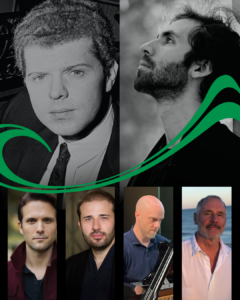
I hope you will join us for what promises to be an extraordinary evening—one that looks back, looks forward, and celebrates the remarkable thread that binds Cliburn, Kantorow, and Tchaikovsky together on our stage.
— Pierre van der Westhuizen, Executive & Artistic Director, The Gilmore Piano Festival
FROM CLIBURN TO KANTOROW: A CELEBRATION OF TCHAIKOVSKY | Friday, May 1, 7 pm | Chenery Auditorium
GET TICKETS