
Pauline Viardot & Frédéric Chopin: Friendship, Salon Alchemy, and a Dialogue Reheard at Gilmore 2026
March 10, 2026
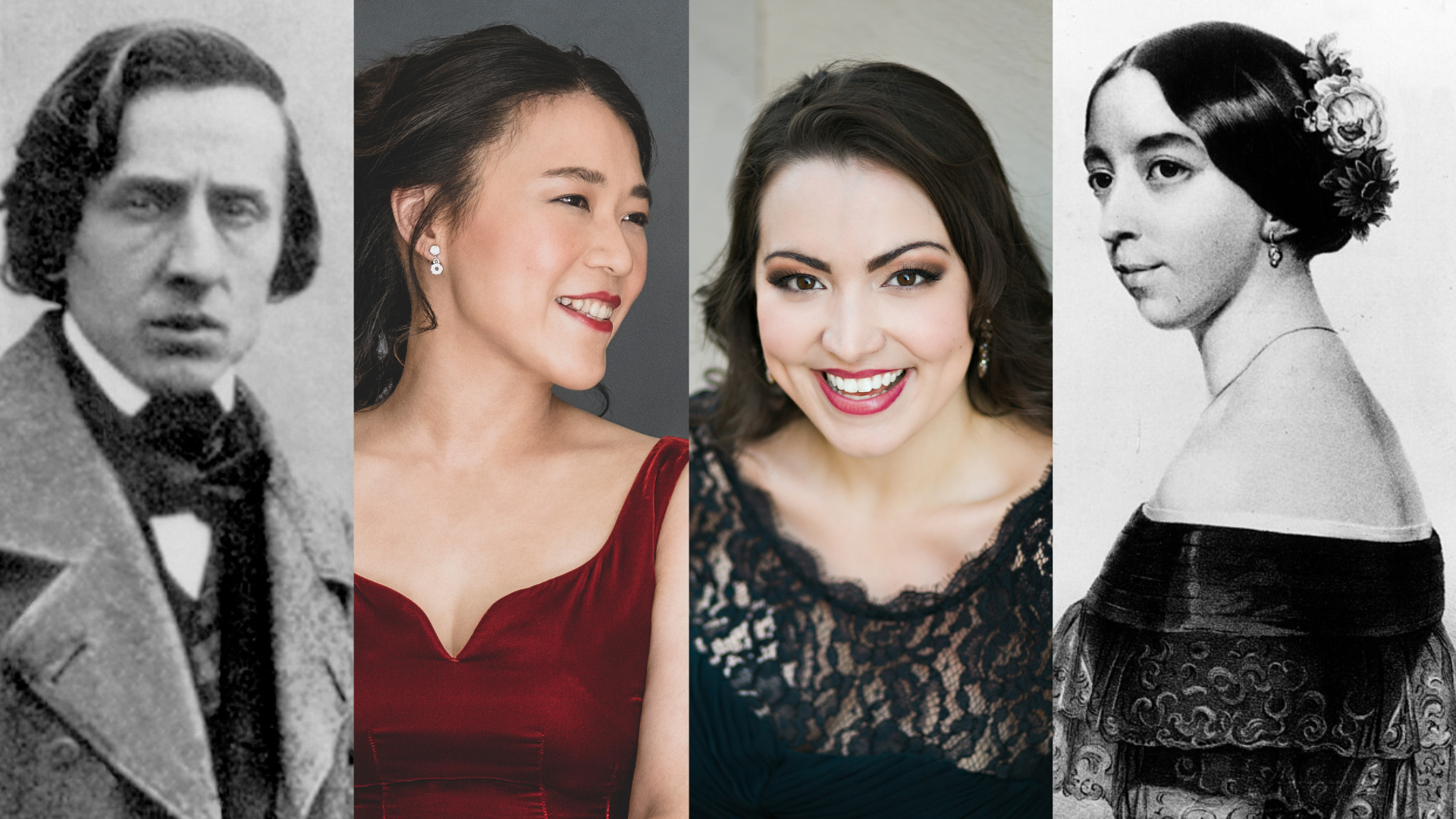
Chopin and Viardot: A Dialogue | Thursday, May 7 | Learn More | Get Tickets
If you love Chopin, you already know the mythology: the poet of the piano, the Paris salons, the summer refuge at Nohant with George Sand. What’s easier to miss is how many of those rooms were shared—with artists who didn’t just admire Chopin, but actively shaped how his music traveled through 19th-century musical life.
One of the most fascinating of those figures is Pauline Viardot (1821–1910): a virtuoso musician who moved as naturally between the keyboard and the stage as she did between languages and cultural worlds. Today, her name is too often treated as a footnote to “bigger” Romantic legends. In Chopin’s circle, though, she was anything but secondary.
The pianist behind the diva
Before Viardot became a world-famous mezzo-soprano, she was a serious pianist—trained in the same high-voltage Paris ecosystem that formed the era’s great keyboard voices. Chopin knew her not only as a singer, but as a musician who could think in harmony, texture, and line. Accounts of their friendship emphasize how often they played together, and how he offered her “expert advice” not only on piano, but on her vocal compositions and arrangements.
That detail matters because it reframes what “relationship” means here. This isn’t a gossip-trail connection. It’s a collegial relationship—two composers/performers sharing craft.
Nohant: where Chopin’s mazurkas learned to sing
At George Sand’s estate in Nohant, music-making wasn’t an occasional diversion; it was the daily air. During Viardot’s visits in the 1840s, the salon culture of the house—practice by day, intimate performances by night—became the setting for one of the most intriguing crossovers in Romantic repertoire: Viardot’s vocal transcriptions of Chopin’s mazurkas.
Chopin’s mazurkas are already “songlike” in their phrasing and breath. Viardot took the next step: she kept Chopin’s melodic spine but enriched it with vocal ornamentation and her own performance instincts, sometimes even adding cadenzas and connective tissue that feel like a singer’s spontaneous speech. (interlude.hk)
Crucially, this wasn’t a case of a star singer simply borrowing a famous composer’s tunes. Multiple sources note that Chopin approved of, and advised on, these arrangements. And the set is preserved and widely circulated today as 12 Mazurkas de Frédéric Chopin (arr. Pauline Viardot), a tangible artifact of friendship translated into repertoire.
Loyalty at the end: the funeral curtain
Viardot’s closeness to Chopin’s world shows up again at a moment that is both symbolic and painfully human: Chopin’s funeral at La Madeleine in 1849. Church rules at the time required female singers to be hidden from view, so Viardot and other women soloists performed behind a black curtain—present and essential, yet literally obscured.
It’s hard not to see the metaphor: women’s artistry shaping the era, sometimes in plain sight, sometimes from behind the velvet.
From Paris salons to Kalamazoo: “Chopin and Viardot: A Dialogue” at the 2026 Gilmore Piano Festival
Fast-forward to the 2026 Gilmore Piano Festival, and that same artistic relationship becomes the core idea—not an aside.
On Thursday, May 7, 2026 (2:00 PM) at Dalton Center Recital Hall (WMU), pianist Charlotte Hu and soprano Raquel González present Chopin and Viardot: A Dialogue, a program designed to reintroduce Viardot to her rightful place alongside the greatest of Romantic composers, explicitly highlighting her friendship and musical partnership with Chopin.
The concert’s structure mirrors the historical relationship:
- Chopin solo piano works that remind us why his keyboard language was irresistible to singers: Polonaise-Fantaisie, Op. 61 and Barcarolle in F-sharp Major, Op. 60, alongside several mazurkas.
- Chopin/Viardot: Viardot’s vocal transformations of the mazurka, presented with their French titles (including “Seize ans!”, “Plainte d’amour,” “Coquette,” and more).
- Viardot’s own music: solo piano pieces (Mazurka, Deux airs de ballet, Sérénade) and original songs for soprano and piano, placing her not only as an arranger of Chopin, but as a composer with her own voice.
Even the framing deepens the experience: there’s a 1:00 PM pre-concert talk with Dr. Zaide Pixley in the Dalton Center Lecture Hall.
Why this pairing works—artistically, not just historically
A soprano and pianist staging this repertoire isn’t a novelty; it’s historically correct. Viardot’s whole point was that Chopin’s dance miniatures could become dramatic monologues—mini-operas in a few pages. And Chopin’s own music, when placed next to Viardot’s compositions, starts to sound less like a solitary genius and more like the center of an ecosystem: friends, collaborators, and brilliant interpreters exchanging ideas.
That’s what makes the Gilmore program feel so apt as a “dialogue.” It doesn’t just tell the story of Viardot and Chopin, it lets audiences hear it in real time, with the same ingredients the 1840s salons prized most: intimacy, personality, and the electric charge of music that sits right at the border between speech and song.
— Pierre van der Westhuizen, Executive & Artistic Director, The Gilmore Piano Festival
CHOPIN AND VIARDOT: A DIALOGUE | Thursday, May 7, 2 pm | Dalton Center Recital Hall
GET TICKETS