
Behind the Music: Pierre Reflects on Hélène Grimaud’s Remarkable Program
March 27, 2025
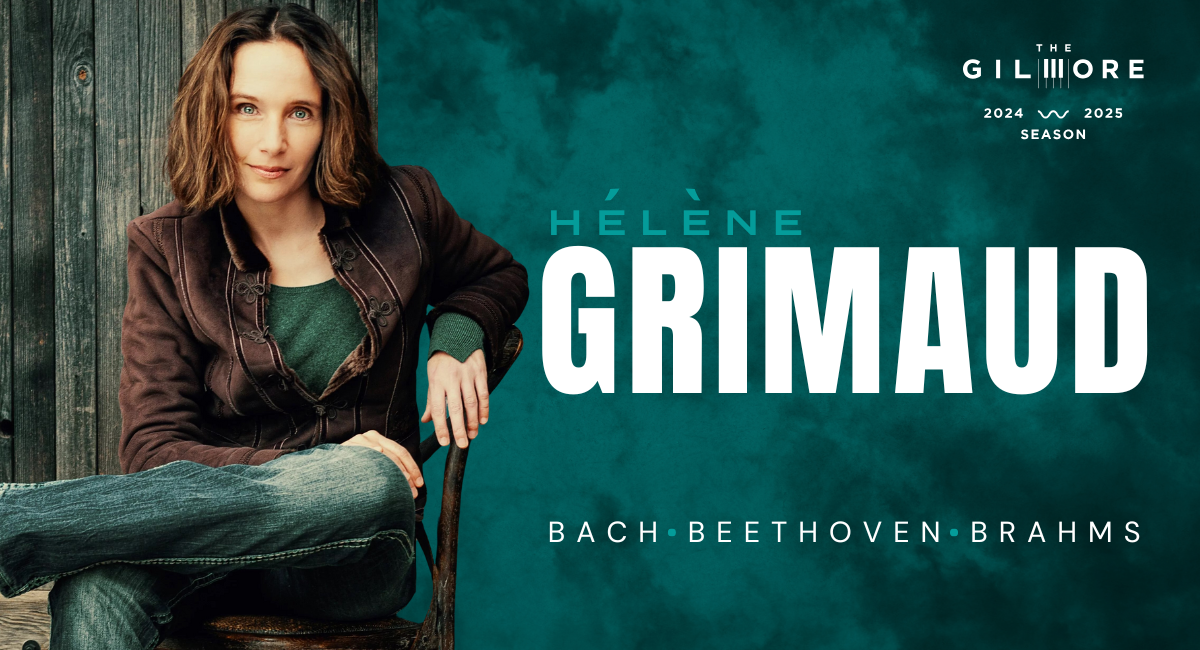
Brahms’ Opus 117 Intermezzi: A Dreamlike Introspection with Hélène Grimaud
Notes from Artistic and Executive Director, Pierre van der Westhuizen
–In anticipation of Ms. Grimaud coming to the Gilmore this Spring, I recently attended a performance at the University Musical Society in Ann Arbor, where she played the works she will be performing in Kalamazoo on April 13, and wanted to share my impressions with you all. I have had an almost lifelong adoration for the music of Johannes Brahms. So, when I experienced Ms. Grimaud’s interpretation of one of his most touching works, I truly felt like I could go the rest of my life with that performance in my memory. She is, in so many ways, a perfect match for this great composer and these soulful gems.
Johannes Brahms’ Three Intermezzi, Op. 117 stand as some of the most intimate and introspective works in the piano repertoire. Composed in 1892, these pieces reflect the twilight of Brahms’ career—works of deep reflection, solitude, and restrained melancholy. Often described as “lullabies to my sorrow” by the composer himself, these intermezzi possess a tender, song-like quality, rich in harmonic warmth and expressive subtlety.
Among the many pianists who have explored these works, Hélène Grimaud offers an interpretation that is deeply poetic and uniquely her own. Known for her keen intellect, technical brilliance, and deep emotional engagement with music, Grimaud brings a perspective that highlights the intermezzi’s dual nature—both ethereal and grounded, distant yet profoundly personal.
The Intermezzi as Musical Soliloquy
Brahms’ Op. 117 consists of three pieces, each bearing a distinct emotional imprint:
- Intermezzo in E-flat Major – Marked “Andante moderato” (Italian for “a moderate walking pace”), the first intermezzo is built around a Scottish lullaby, “Sleep softly, my child, sleep softly and well!” This piece floats with a gentle, hymn-like simplicity, its repeated phrases evoking a sense of hushed reverie. Yet, beneath its surface calm, there is a deep well of nostalgia and longing.
- Intermezzo in B-flat Minor – Often considered the most sorrowful of the three, this piece unfolds with a restless, sighing motif, shifting between shadowy uncertainty and lyrical beauty.
- Intermezzo in C-sharp Minor – A piece of resignation and quiet contemplation, the final intermezzo drifts between mystery and warmth, its harmonies wandering in search of resolution.
Hélène Grimaud’s Perspective: A Search for Transcendence
Grimaud’s playing is often described as deeply personal and instinctual, qualities that make her interpretations of the Op. 117 intermezzi particularly compelling. In her hands, she approaches these works not just as nostalgic meditations but as deeply philosophical explorations of solitude, memory, and transcendence.
- A Lyrical Yet Architectural Approach
Grimaud has a way of balancing lyricism with structure, ensuring that the music never becomes indulgent but retains its natural ebb and flow. In the first intermezzo, she allows the melodic lines to breathe, shaping each phrase with a vocal quality, as if Brahms himself were whispering a lullaby from another realm.
1st Intermezzo. LISTEN HERE
- A Nuanced Use of Tone and Pedal
Her signature use of touch and pedaling creates an almost liquid sound, a hallmark of her style. This is especially evident in the second intermezzo, where she emphasizes its ebb and flow of tension—the left-hand figures sigh under the melody, each phrase unfurling like a lament.
2nd Intermezzo. LISTEN HERE
- Intimacy Without Sentimentality
While some interpretations lean into the deep melancholy of these pieces, Grimaud brings a sense of quiet resilience to the music. There is an underlying strength in her phrasing, a quality that keeps the pieces from sinking into despair but rather lifts them into a space of profound contemplation.
- The Third Intermezzo: A Dissolving Reality
The final intermezzo, under Grimaud’s hands, becomes almost weightless—a piece that drifts between reality and dream, its harmonies dissolving into silence. Her interpretation invites the listener into a liminal space, where time feels suspended, and the music becomes an inner dialogue between past and present.
3rd Intermezzo. LISTEN HERE
Conclusion: An Eternal Lullaby
Brahms’ Op. 117 intermezzi remain among the most personal and tender works in the piano repertoire, and Hélène Grimaud’s interpretation brings out their timeless quality—where sorrow and beauty coexist in perfect balance. Through her, these pieces become more than just reflections of the composer’s late style; they become a meditation on memory, loss, and the fleeting nature of human experience.
I hope you’ll join me in this discovery on April 13, when the magnificent pianist comes to Chenery Auditorium. Full program and details here.
See you soon,
Pierre